Spin&Go GTO specialist among the school’s coaches (interview)
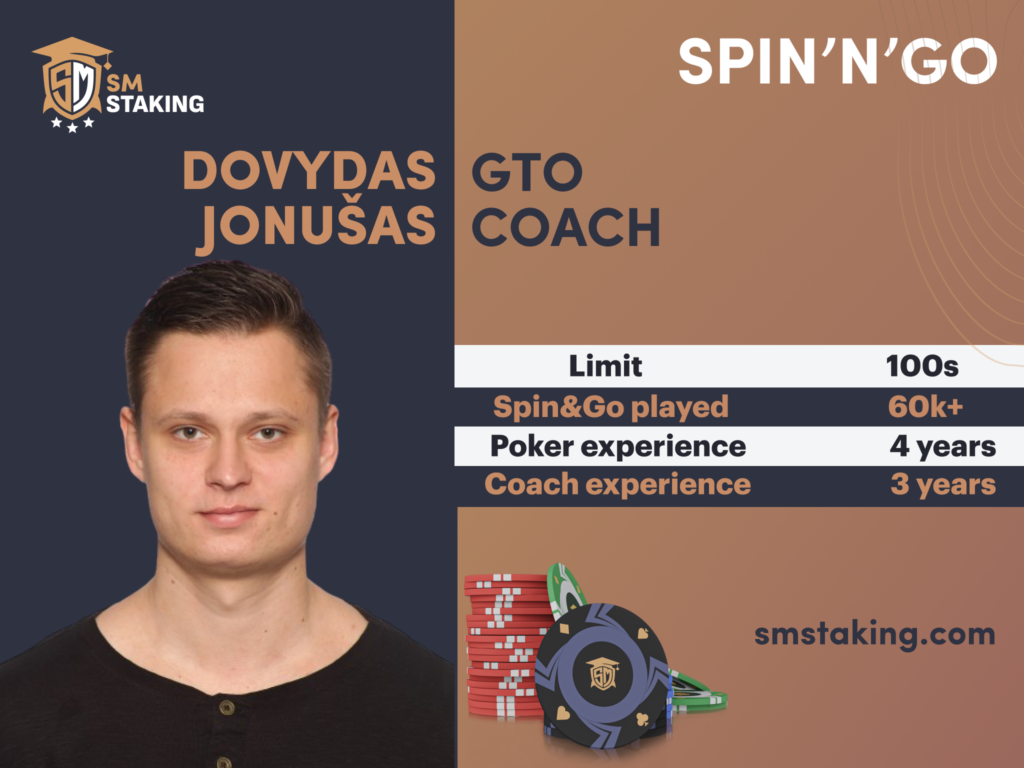
How I started my poker career After joining SM Staking and starting his career in the 5s limit, he rose to 50s in the shortest amount of contract games. He did it in about 6 months, which is why he got an offer to join the SM coaching team. A coach who focuses on the quality of the game rather than the number of games, Pure GTO specialist Dovydas Jonušas. How did you become a Spin&Go player who managed to climb the limits so quickly? I came to SM Staking as a 5s limit player, still quite “green” so to speak. After playing 1k games I went up to 10s limit, after playing 4k more games (about 3 months) I went up to 25s limit. It took about 3 more months to reach the 50s limit. All in all, I went from 5s to 50s in 6 months. Of course, it would have been impossible to go up the limits so quickly without SM Staking. The school gave me access to a huge library of information, organised group lessons and a personal trainer. I did what was necessary – I set a clear goal that I wanted to become a poker professional. Before that, I was working in an office, so I gave myself six months and set myself the condition “either I get serious about poker or I go back to the office”. My goal was not to play 5s limit, my goal was to go up in limits. When the part was spinning a higher volume of games, I was concentrating on the EV of the game. More than half of my time was spent learning strategy, raising the quality of my game. First I learnt to play better and then I started to increase the number of games. What’s important to improve quickly in Spin&Go? A professional approach to poker. We all have what is called an ‘A game state’ where we play our best poker, but it is important to understand that this state is not random. The preparation we do for our play sessions and the work we do on ourselves in between them determines how often we show our best game. The intense competition in poker encourages discipline, good habits and personal development. Therefore, I encourage you to take an interest in psychological health, read self-help books, and find ways to keep yourself focused during the game. How and what methods do you use to help students achieve their goals? Very simply, we try to create a standard routine. We find out what the student’s short-term and long-term goals are, we find out what the main problems and mistakes are at the moment, and then we start to follow the routine to improve the quality of play. Poker doesn’t stand still, so I try to help as much as possible, both in terms of strategy and well-being. It should also be stressed that there are some things you can’t find described anywhere on the internet. And poker itself is becoming more and more complex, so a coach is needed to make it quicker and easier to become a professional poker player. Why do you like coaching? First of all, I spent a lot of time analysing Pure GTO situations. I like to study hands and even more to discuss them. When I teach lessons, I not only pass on the knowledge I have gained, but I also polish my own game. When training others, most situations are encountered hundreds of times, which allows you to grasp them to the level of automatism. When you see that someone else cares about my lessons and is able to absorb them, you feel the meaning of what you are doing. Working in the office, I gained experience in training new people, coordinating them and helping them to develop their skills. In general, I don’t like it when explanations are complicated, so I try to keep it simple and make the training and the discussion easy and understandable. I use everyday examples to present the information, and most importantly I focus on the thought process: how did you get to the mistake, how did you make the decision, rather than just solving the small mistake at hand. What advice would you give to a poker enthusiast? I probably won’t say anything new, certain things are essential, like spending at least half the time studying poker. Learn the basics later, learn the basics well at the beginning and raise your limit. Putting the emphasis on ChipEV rather than the number of tables and games is the best choice. And the smartest thing to do is not to waste time trying to learn Spin&Go on your own and join SM Staking. At the school you will get a top-class information base, the attention of a personal trainer, and other benefits that you can’t find anywhere else.
Spin&Go GTO specialist among the school’s coaches (interview) Read More »